Week 1: Know Yourself
Goal
By the end of the week, students will have reflected on their personal motivations and professional goals, practiced with practical self-awareness frameworks, and connected these insights to understanding how they can best contribute within a team.
Expected Results Before This Week
Weekly Progress Check rules
- Be prepared to show your results at the beginning of class.
- Presenting teams are selected randomly each week. The same team may be selected repeatedly.
- If your team is selected and there is no relevant work recorded before the session, 3 points will be deducted. Any relevant demonstrable work avoids the deduction: the weekly score is then between 0 and +3 points, depending on quality and completeness.
- A missing expected result can cause a point deduction only once, but you should still catch up: later work may depend on it, and these results usually contribute to the tasks required for your desired grade. More about salary for tasks
How Weekly Progress Checks work · More about penalty and bonus points
This week's expected results
- Introduce yourself to the others with something meaningful beyond your name and basic facts: give them a small sense of who you are, what interests or motivates you, or what it might be like to work with you. This first week is a dry run: there is no point deduction, but an exceptionally professional introduction may earn bonus points.
Notes for tutors:
1: Icebreaker
Why is this useful for me?
Things you learn and experience in this session will help you to solve the following tasks:
Activities
- why are you here?
- what a software engineer does?
- you and the GPT
- discuss
- "most probable ≠ correct"
- "LLM will always give you the average answer"
2: Course Introduction
How to use the course homepage?
We encourage students to explore the whole course homepage. But students have to be familiar with Home, Contact, Grading, and Deadlines (and related) pages as early as possible. Other pages will be introduced later.
Follow the schedule
The topics of each week are listed under the Milestones page. Students should focus on the current topic for each week but overview the next week. Background and additional materials will be available from the current topic page.
Activities
Student should have dedicated time to explore the course homepage and ask questions if they have any, while the tutor is available to help.
- Students should read the Home, Contact, Grading, and Deadlines pages now and ask questions if they have any.
- Students should explore the Milestones page and overview.
- Students will get weekly reports at their university email address about their progress. A sample report.
- Focus your effort on the tasks marked as "in progress", but overview upcoming tasks as well.
- The report is static and will not be updated until the next report is sent. Each report overrides the previous one.
- The only wrong question is the one that is not asked. Please ask questions if you have any!
3: D.U.M.B. Goals
Why is this useful for me?
Things you learn and experience in this session will help you to solve the following tasks:
Background
Activities
Collect DUMB goals on the board
- All students write down at least 3 DUMB goals.
- Tutor draw a table on the board like below:
| Dream-Driven | Uplifting | Method-Friendly | Behavior-Driven |
|---|---|---|---|
| ... | ... | ... | ... |
- Some students share their goals and fill in the cells with a word or a short phrase.
4: S.M.A.R.T. Goals
Why is this useful for me?
Things you learn and experience in this session will help you to solve the following tasks:
Background
Activities
Collect SMART goals on the board
- All students write down at least 3 SMART goals and map them to DUMB goals.
- Tutor draw a table on the board like below:
| Specific | Measurable | Achievable | Relevant | Time-bound |
|---|---|---|---|---|
| what? | done? progress? | knowledge & circumstances | DUMB goal(s) | deadline? |
| ... | ... | ... | ... | ... |
- Some students share their goals and fill in the cells with a word or a short phrase.
5: Intermediate Topics
Why is this useful for me?
Things you learn and experience in this session will help you to solve the following tasks:
Personality Tests
Background
Activities
My Personality
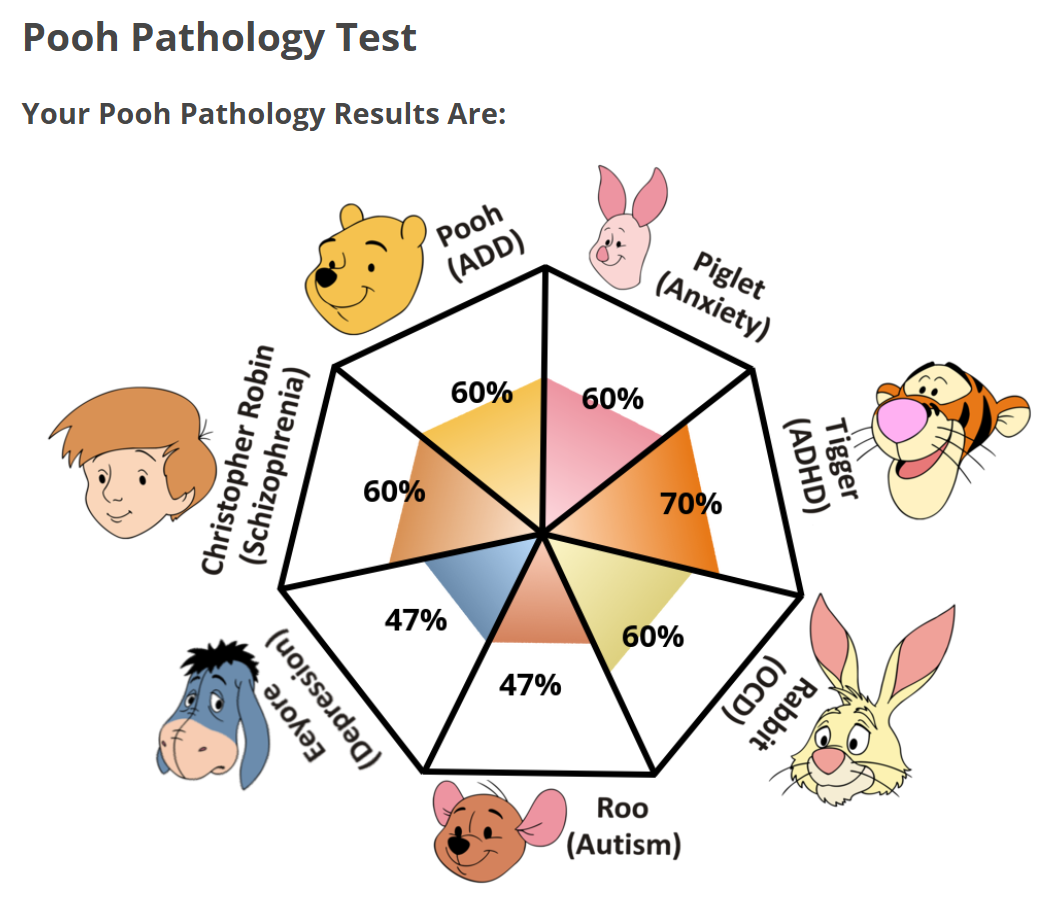
- Students fill the Pooh Pathology Test and the 16 Personalities
- Tutor draw a table and figure on the board, similar to these:
| Thinking (T) + Judging (J) | Thinking (T) + Prospecting (P) | Feeling (F) + Judging (J) | Feeling (F) + Prospecting (P) | |
|---|---|---|---|---|
| Introverted (I) + Intuitive (N) | Architect (INTJ) | Logician (INTP) | Advocate (INFJ) | Mediator (INFP) |
| Extraverted (E) + Intuitive (N) | Commander (ENTJ) | Debater (ENTP) | Protagonist (ENFJ) | Campaigner (ENFP) |
| Introverted (I) + Observant (S) | Logistician (ISTJ) | Virtuoso (ISTP) | Defender (ISFJ) | Adventurer (ISFP) |
| Extraverted (E) + Observant (S) | Executive (ESTJ) | Entrepreneur (ESTP) | Consul (ESFJ) | Entertainer (ESFP) |
Students mark and discuss their results and how they relate to their behavior. For example write their initials on the board figure above or tutor write the counter of each type.
Misuse of Personality Tests
Students collect and then discuss the common pitfalls of applying personality tests.